Hu Zhengyan [Hú Zhèngyán]
Shizhuzhai Jianpu [Shih-chu-chai chien-p’u]
Jung Pao-Chai, Beijing, 1952
Beschreibung
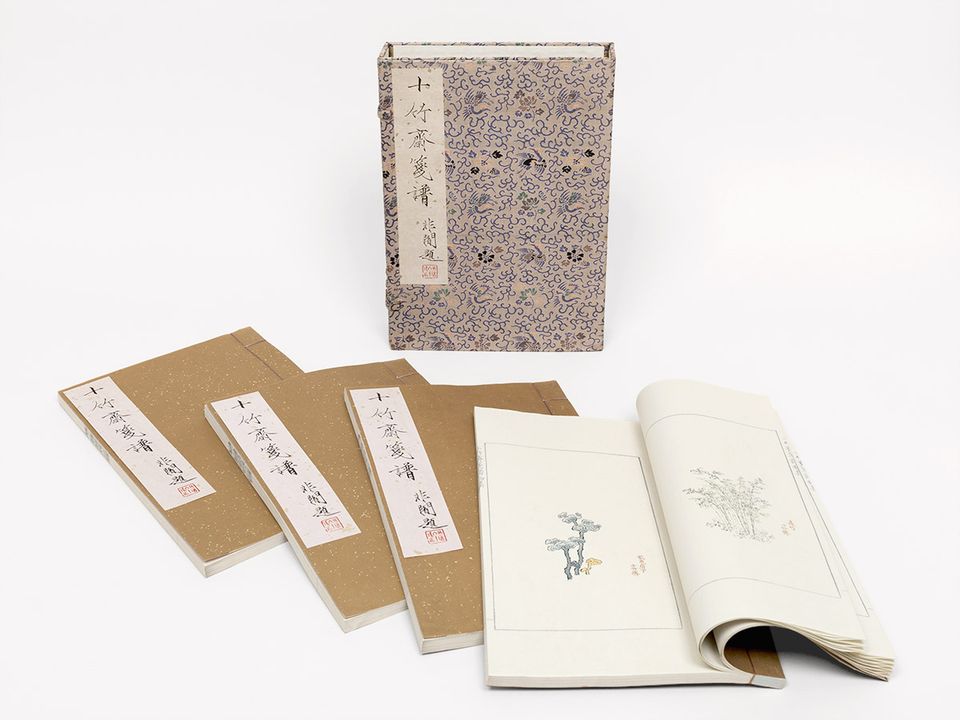
A masterpiece of Chinese multi-block colour printing, masterfully reprinted, in exactly the same technique as the original and printed on the most magnificent paper.
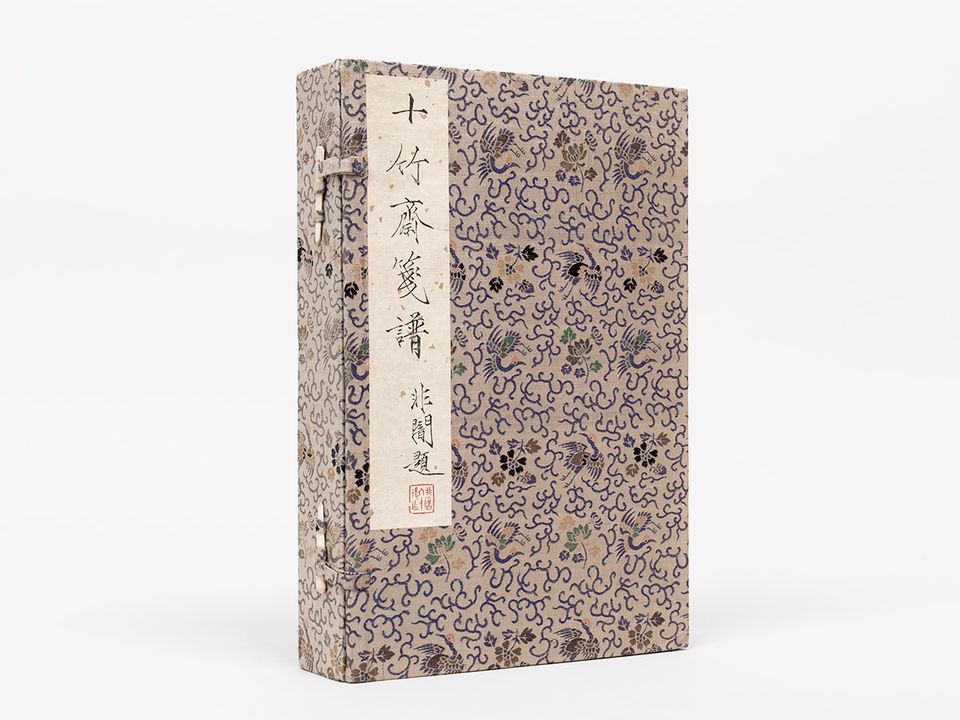
Description: 4 vols. stab bound with gold speckled, ochre coloured paper wrappers, paper label with calligraphic lettering to front; housed in the original silk brocade folding box with calligraphic paper label and 2 bone clasps. Quarto 31 × 21 cm; unpaginated. With 283 woodblock prints on double-folded leaves (coloured [taoban], black and white, embossed [gonghua]).
Ref.: Cahill, Pictorial Colorprinting in China and Japan; Tschichold, 1970; Wright, Fashioning Biography
Condition: An excellent copy.
Notes: Hu Zhengyan (ca. 1584–1674), a publisher from the late Ming/early Qing dynasty, is one of the most frequently studied figures in the history of Chinese prints. He arrived in Nanjing in 1619, where he opened a print shop called Shizhuzhai (Ten Bamboo Studio). A successful publisher and businessman, Hu produced a variety of books and served as supervisor of carving, collator and editor. He was also renowned as a calligrapher, seal carver and producer of inks and letter paper. Alongside the renowned Shizhuzhai shuhuapu (Ten Bamboo Studio Manual of Calligraphy and Painting), the Shizhuzhai jianpu (Ten Bamboo Studio Letter Paper), published in late 1644 or early 1645, is another notable example of the intricate Chinese multi-block colour printing technique.
The Shizhuzhai jianpu was produced to promote one of the Ten Bamboo Studio’s products: letter paper. James Cahill discusses the status of these high-quality papers in Chinese society during the late Ming period: “The letter papers testify to the taste of the people for whom they were intended and to their self-confidence in overlaying calligraphy and poetic or epistolary sentiments on such exquisite grounds.”
Jan Tschichold wrote about the 1952 reprint of Jung Pao-Chai’s Shizhuzhai jianpu: “Just like the original, the reprints belong to the greatest masterpieces of the art of printing. They are reproduced with admirable accuracy, printed using the same technique as the original on the most splendid paper, and they replace the only original copy perfectly, as hardly any other reprint of an old work does.”